About TAKANAWA GATEWAY CITY
ABOUT TAKANAWA GATEWAY CITY
People, nature and technology
Connecting,
The most vital in the world
To the overflowing city.
Takanawa inherits an innovative split from its history as the launching place for the country's first railway.
In honor of this, we aim to create an experimental site
where we create ways to lead a fulfilled life a century into the future
in order to build a city where continuously inspires the birth of new culture and business
with various collaborative partnes as well as the local community.
-
Development History
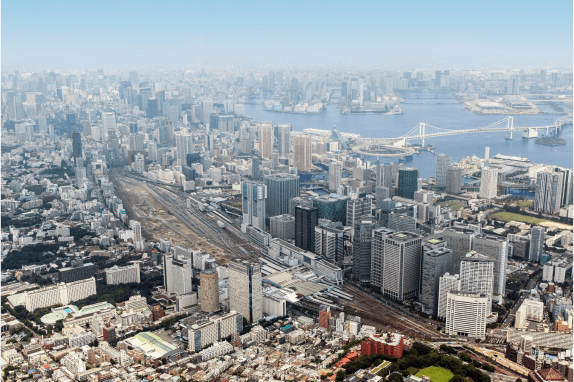
During the Edo period, this area served as the "gateway" to Edo as Takanawa Okido, and during the Meiji period, it was the site of innovation, combining Japanese and Western technology, when Japan's first railway was built. After that, even after the era of Japanese National Railways and the establishment of JR-EAST, it was mainly used as a depot for Tokaido Line and Sleep Limited Express trains.
As times changed, the opening of Ueno-Tokyo Line and the decline of Sleep Limited Express made it possible to reduce the number of cars stored at the depot, leading to the streamlining of the depot. This freed up approximately 13 hectares of land, and development plans were put forward to make effective use of this vacant land. -
Facility Overview
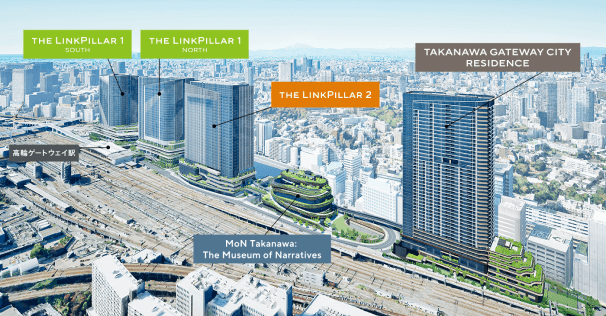
TAKANAWA GATEWAY CITY is undergoing urban development that is one of the largest in Japan, with a total floor area of approximately 845,000 m2.
Shinagawa Station, which serves as a wide-area transportation hub, TAKANAWA GATEWAY Station, which has excellent access to terminal stations in the city center, and Sengakuji Station which has excellent access to Tokyo's subway network and Haneda Airport will work together to form a "Global Gateway," an international exchange hub that will bring together people from the surrounding areas, all over Japan, and all over the world.
The name of the building is a combination of "Link," which means "connecting everything, continuing to co-create and grow for the future," and "Pillar," which conveys the meaning of "continuing to grow as a pillar and a testing ground for enriching lives 100 years into the future."
Using the station-area integrated urban development as a testing ground, we will work with a variety of partners to create solutions that contribute to resolving global issues from TAKANAWA GATEWAY CITY. -
What is Takanawa Embankment?
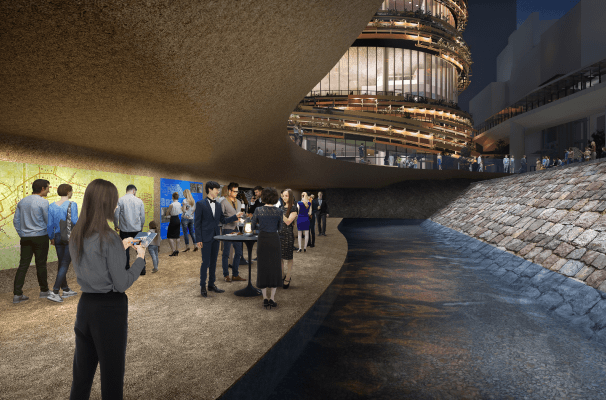
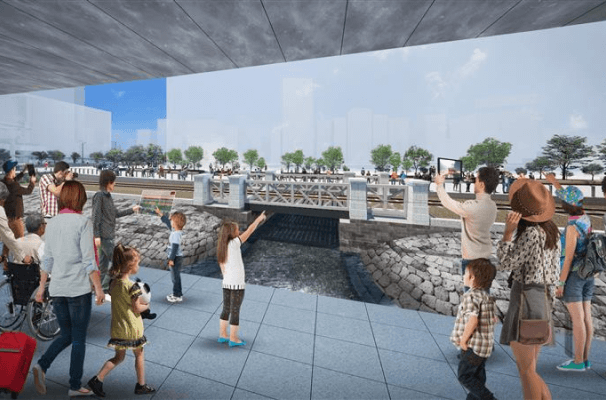
The Takanawa Embankment is a railway track laid in 1872 (Meiji 5) when Japan's first railway opened between Shimbashi and Yokohama, in order to run the train over the sea along the Takanawa coast.
Through the preservation and utilization of the Takanawa embankment unearthed during urban development, we aim to pass on the memory of this innovative site, where Japan's first railway ran, to the next 100 years, thereby enhancing the historical value of the region and realizing "Shinagawa as an international exchange hub."
In addition to the on-site preservation and public opening (spring 2028) of the 7th Bridge section and the park section, which are designated as national historical sites, the signal base will be relocated, preserved, and opened to the public, allowing visitors to experience the scenery as it was at the time. Furthermore, through exhibits utilizing cutting-edge technology, visitors will be able to experience the innovations of the railway's opening period.
Regarding efforts to preserve and pass on the Takanawa Embankment, we are proceeding with our considerations while receiving advice and support from experts in various fields and relevant government agencies.Including efforts to preserve and open the site to the public, we are launching "THE FIRST RAILWAY PROJECT" as an initiative to connect the history of Japan's first railway to the future, inheriting the innovative spirit of the railway's opening period and passing it on to the next generation.
Since March 2026, a gallery has been open on the first floor of THE LINKPILLAR2, where visitors can learn about the history of the railway line between Shimbashi and Yokohama, and the research and excavation of the Takanawa embankment, through photographs and interview videos. For more details, please visit the website via the link below. -
TAKANAWA GATEWAY CITY 's vision: Three themes
-
Achieving a Zero Carbon society
We are striving to conserve and produce energy and implement energy management to achieve net-zero CO2 emissions.
Planned power generation facilities include wind, solar and geothermal to achieve our goal of producing renewable energy. Further we plan to harness in-building biogas power generation to food waste into energy, which will help achieve a circular economy. We plan to use fuel cell trucks for transportation of goods within the city and promote hydrogen gas.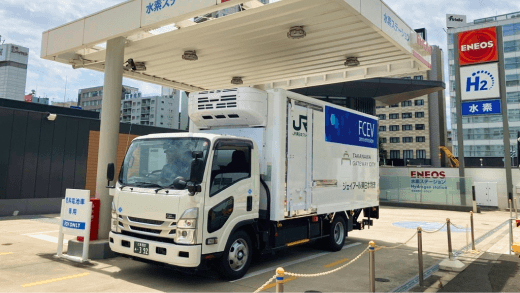
-
Mobility: Co-creation between humans and robots
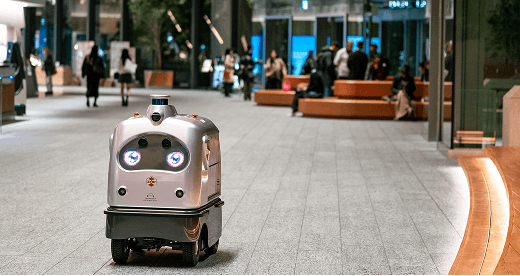
In today's world, where new technologies are born every day, in order to bring them back to people's lives, it is necessary to actually incorporate them into daily life and business and experience their convenience and effectiveness. For this reason, it is essential to go through the phase of exploring how to incorporate them into real life and how to return benefits to consumers. At TAKANAWA GATEWAY CITY, we aim to create a "people-centered" lifestyle that is not bound by age or place of residence by coexisting with robots and mobility, and we will explore how to return benefits to consumers through demonstration experiments.
-
-
Healthcare: Creating a lifestyle where everyone can live a fulfilling life for 100 years
We will collaborate with academia, including The University of Tokyo GATEWAY Campus, which is our partner in the city, and startups, to create services that utilize cutting-edge knowledge, such as optimal sleep, new diets, and improved physical function.
The system will be tested at TAKANAWA GATEWAY CITY in conjunction with Suica data, and will then be expanded to other parts of Japan through networks such as the Smart Health Station®.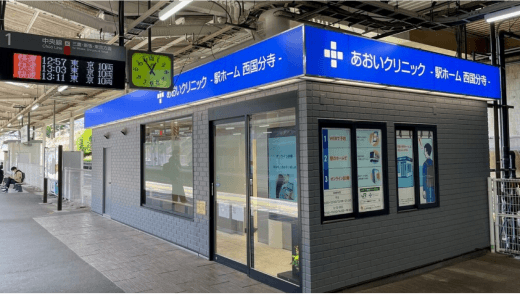
-
-
Environmentally conscious urban development
In order to promote environmentally conscious urban development, TAKANAWA GATEWAY CITY has obtained environmental certifications from "LEED® (*1)," a globally widely used environmental certification program, and "BELS (*2)," a building energy efficiency performance labeling system that is popular in Japan. The city is working on measures that take sustainability and environmental impact reduction into consideration within its urban development.
After the grand opening, we are not only continuing with conventional energy-saving measures, but are also challenging ourselves with new energy management approaches that start with people's behavior and comfort, in order to achieve carbon neutrality.Environmental certifications obtained during this development
-
1.LEED®
Entire development area
LEED® ND
Plan(v4)Gold Certification
THE
LINKPILLAR 1LEED® BD+C
CS(v4)Gold Certification
THE
LINKPILLAR 2LEED® BD+C
CS(v4)Gold Certification
-
Entire development area
LEED® ND Plan (v4) Gold Certification
Obtained in October 2020
-
THE LINKPILLAR 1
LEED® BD+C CS (v4) Gold Certified
Acquired in October 2025
-
THE LINKPILLAR 2
LEED® BD+C CS (v4) Gold Certification
Acquired in March 2026
-
-
2.BELS
THE LINKPILLAR 1
★★★★☆☆ (4 out of 6 stars)
THE LINKPILLAR 2
★★★★☆☆ (4 out of 6 stars)
MoN Takanawa: The
Museum of Narratives★★★★☆☆ (4 out of 6 stars)
-
THE LINKPILLAR 1

-
THE LINKPILLAR 2

-
MoN Takanawa: The Museum of Narratives

-
-
※1 LEED®
LEED® is a leading program for the design, construction, maintenance, and operation of high-performance green buildings.
This is an international evaluation system that assesses the environmental performance of buildings, urban development, and community building in four stages: standard certification, silver, gold, and platinum.
LEED® and related logos are trademarks owned by the US Green Building Council® and are used with permission. -
※2 BELS
This system, operated by the Japan Housing Performance Evaluation and Display Association, is a system in which a third-party organization evaluates and certifies the energy-saving performance of buildings. Based on national energy conservation standards, it is a domestic evaluation system in Japan that clearly displays the energy consumption performance of buildings using a star rating system.
-
-
TAKANAWA GATEWAY URBAN OS
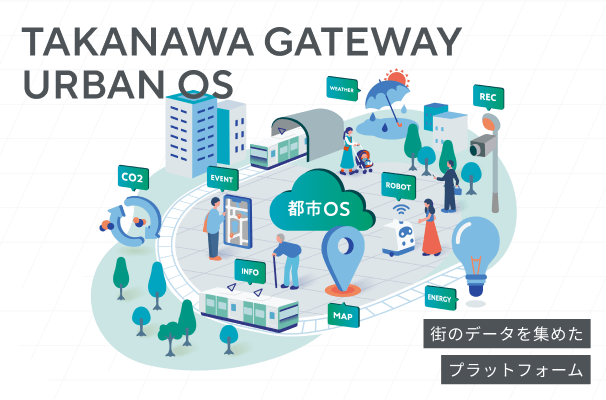
TAKANAWA GATEWAY URBAN OS is a data sharing platform (urban OS) that stores information on the entire city, including commercial, office, and residential areas, as well as railway operation data held by JR-EAST (train location, on-board congestion, and ticket gate passing information).
The vast amount of data held by TAKANAWA GATEWAY URBAN OS can be used to plan events and develop products that are tailored to the lifestyles of customers.